Back to square three. In the great debacle of attempting to gain drinkable water at Plan473, the city was contacted in regards to the cost estimate for having city water brought down. Last year when working through the due diligence before buying the land, a utilities request was completed confirming or denying city water, septic, and gas. City water and gas required an extension and city sewer required engineer.
From the numerous other properties looked at over the course of a year, it became apparent city sewer was found in a very small portion of the city and an even smaller portion in the county. Therefore being told city sewer was "not gonna happen, ever" was not news. Being told city water and city gas was just the cost of the extension, well ok, that is completely do-able. Besides, having a well dug is to standard operating normal here in the great city. Hells bells, there are million dollar homes with both well and septic because having city utilities is just not an option.
However, with the well undrinkable and RO system out of the price, it was decided to have the cost estimate done for city water to be brought to our address. Holy moly, good grief, and is that legal? In order for city water to brought 1600 feet to our property, it would cost between $32-$38 per foot. That's is over $60K! And let me tell you, city water is not all that great in the taste department. In a city and county of just over 20K people, there are close to ten water stations. You know the places where you refill your own water jugs at a cost per gallon. Like Culligan water, but not in your home. Having that many stations in this tiny area tells me other people find the city water and their own well water to be undrinkable too.
At this time our only choices for obtaining water are in these, IBC totes. They are cheap to acquire, especially if purchased used, come in various sizes, are adapted with spigots at the bottom and large ports on the top, and have their own carrying systems. People have been using them for years for hauling and storing water. However, most people using them are for places with no water in desolate regions. West Texas for example, where it never rains. Other people use them for rain collection purposes and we will do that too. Just not right now. Right now, we will use them to haul to several friends to collect water from their wells. These are friends who have both city water and personal wells. While this is only a temporary fix, it will hold us over for a while. When filled, these totes will hold 935gallons. For people who are water conscious, this amount will last several weeks, even close to two months. Living off tote water is not for people who live in two bedroom, two bath, two laundry loads a day homes. Living off tote water is not for the people, who use according to EPA, over 100gallons a day. Yes, I repeat in case you think you read wrong, a 100gallons a day per person! And that amount of water consumption is for another post all together on another day. How much water do you use a day?????
Let me start out right now by warning you this post is long and detailed with no pictures.
After ten long days of testing and a nine-page report, it was determined by the independent lab, our water was the worst of all waters. It took them nine pages to tell us what we already knew, our water problems were far from over. It took them nine pages to inform us our water contained 6359mg/l of total dissolved solids. What does that mean exactly? Oh, that's right, it took them nine pages to confirm our water was both hard and salty.
Let us not be too harsh, over 20 other elements were found within the sample. And hey, on the positive note, no harmful elements were found. There was no arsenic or lead or mercury. There was no chlorine or fluoride, both of which are found in city waters all across this great nation. So yeah, there was positive results on this nine-page report. It just wasn't the results wanted.
According to www.water-research.net"dissolved solids" refer to any minerals, salts, metals, cations or anions dissolved in water. Total dissolved solids (TDS) comprise inorganic salts (principally calcium, magnesium, potassium, sodium, bicarbonates, chlorides, and sulfates) and some small amounts of organic matter that are dissolved in water." The more TDS in the water, the less safe it is to drink.
What exactly is drinkable water? That is an answer without a simple, straight answer. As described by the EPA, primary drinking water regulations are "legally enforceable standards that apply to public water systems" and secondary drinking water regulations "are established only as guidelines to assist public water systems in managing their drinking water for aesthetic considerations, such as taste, color, and odor. These contaminants are not considered to present a risk to human health". The EPA states "drinking water averages between 200 and 300 milligrams per liter total dissolved solids and water with TDS greater than 500 milligrams per liter is not recommended for human consumption." Ah-hem, 500mg/l of TDS. Ok then, as it turns out, the well water is just a little over the safe drinking range. It's a good thing we don't live in the dark ages.
Modern man has the ability to remove TDS resulting in drinkable water. Removing TDS from water is not new science. This has been done for years, hence the popularity with bottled waters, through a process known as the reverse osmosis (RO) system. In the RO system, water is passed through a membrane under pressure removing particles from the water. RO systems can be bought at the local home improvement stores and are small enough to fit under the average sink for drinking water or designed especially to meet special water needs large enough to handle full, top of the line cruise ship where thousands of gallons an hour are created from salt water. Systems, no matter the size, are both costly and wasteful. Costs can vary from a few hundred dollars a year, maintenance included, to hundreds of thousands of dollars where yearly maintenance still costs several thousand dollars more. For every gallon of RO water, one gallon of waste water is removed. RO systems are so effective in their duties, they remove all elements from the water leaving the water tasteless. Tasteless water is not only deeeee-sgusting to drink straight from the tap, it will also absorb the flavor of the container in which water is passed through and stored. Don't get me wrong, water completely removed of all elements that is used to brew tea and coffee, is the best ever! But that is the least of our concerns right now. Plan473 needs drinkable water, not the best water.
Lab results were sent to a RO specialist based out of Florida and just a few days later they called back with a price starting point. For water of our severity, a salt water RO system would cost $25K. This does not include shipping, installation or yearly maintenance costs between $1800-$2400. Yozers! To effectively filter our water through several membranes, the system required the use of a 800psi pump. These systems are very common, produce 2000 gallons of water daily, and require regular usage to maintain effective filtration. Therefore, it is not possible to turn the system on once a month to fill a holding tank. In conclusion, not only is the system too costly, it produces more water than needed. Not in the market of wasting water to create water, obtaining affordable drinkable water is back to square one. No, wait, square three. Square one was city water, square two was well water., so yeah, square three.
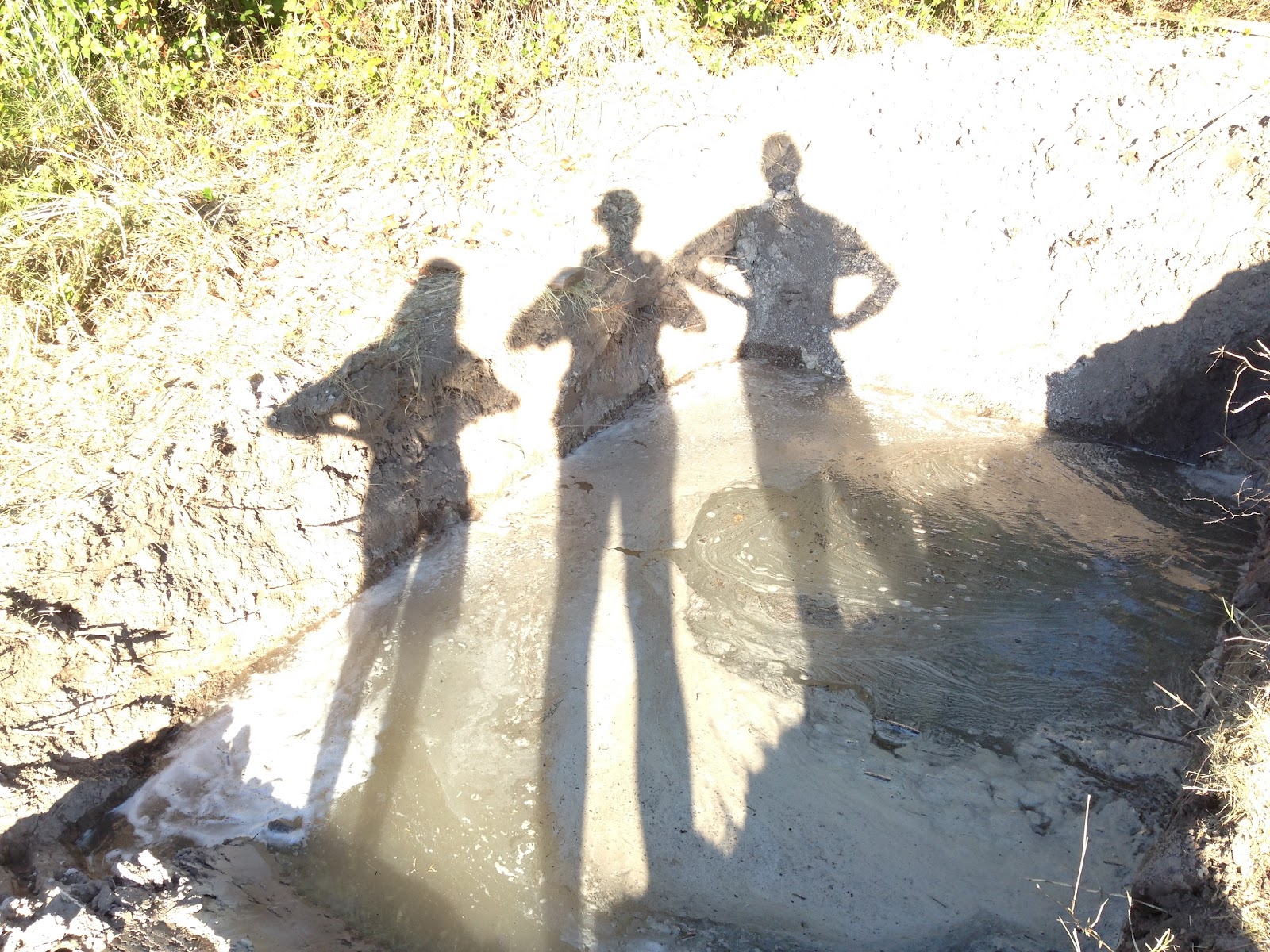
In the attempts to remain positive while the well water is being tested at an independent lab, a hole is being dug. Yes, another hole. These boys and their holes. Yesh.
Why the hole you ask? Well, it's for the well. The well water that is. For the third time in as many weeks, we will be attempting to flush the well in hopes for better water. This time instead of allowing the water to drain into the field, the water is going to be contained. Hence, the hole.
Digging the hole will answer many questions. What type of soil is located below the shallow top layer? How far down can a hole be dug before the tide level water seeps through? Knowing this allows for a more accurate design of structure footings. After filling the hole with well water and determining the amount of water held, absorption time can be monitored providing the rate at how much gray water can be filtered.
Of course, there are other reasons to dig a hole. First and foremost, because you can. Secondly, it creates a great playground. The kid couldn't wait to get in there and get dirty. The mind of a child is a precious thing wasted on adults. His sole focus was on his collection of dirt clumps. He was creating a pile of the best of the best of the best. He would climb into the hole to find the best clump of dirt after each tractor bucket full was removed. What he failed to notice was each time he came back up, the clumps were of a different layer of soil, each one lighter in color than before.
It did not take too many bucket fulls before the tide level was achieved and salt water started seeping into the hole. Several more bucket fulls were removed before the hole became too steep for the tractor.
Just in the few minutes it took to park the tractor and measure the hole, the hole had gained a substantial amount of water. Yes, the answer to your thought, it's salt water. Why you would have thought differently is beyond me. It is not like our water was drinkable from the well so what makes you think shallower water would be any more or less salty? Did I say you this whole time, oh excuse me, I meant me. To say the least, I was quite disappointed after crawling into the hole to realize the water was just was salty as it was from the well.
Oh, well. At least this hole served a purpose, unlike The Hole to Nowhere. A trench was dug, the generator was attached, and the hole was filled.
Water moving, be it in a creek or a river, trickling or raging, is mesmerizing. This event was no different.
Ok, so it was only mesmerizing for a little bit. There was the occasional mudslide into the hole but other than that, it was like watching paint dry. At twelve gallons a minute, the hole, as it turned out, was just big enough to hold 720 gallons of water. Well, salt water. Not to be confused with salty well salt water or just plain well water. It held 720 gallons of salt water from pumped out of the fresh water well.
The water level was measured to determine how quickly water is absorbed. Just a few days after the flooding during the summer, there was very little standing water other than in drainage ditches. Standing water is bad. Standing water becomes stinky, makes driving a mess, and it promotes mosquitoes. Ugh. Just what we need, the promotion of more mosquitoes.
So as we stood there contemplating the fact our water remained salty we dreamed a Peter Pan moment. Sometimes it is easier to live in Never Never Land. Sure there are bad alligator clocks and a mean pirate but you get to live in a tree house and are friends with a fairy. Oh, and you can fly away from your problems and there is plenty of fresh water!
As it turns out, water absorption in the hole took longer than expected. The next afternoon, there was still a fair amount at the bottom of the hole. What was more unexpected was the level of salt in the water. We know the preliminary tests state there is a high level of salt in the water but when the water dried off the tractor ruts, salt remained. This was not a dusting either. This was a thick layer that shone like glitter in the sunlight. And since you don't know much about me, let me state that I HATE, HATE, HATE glitter! Was the strong enough for you? I HATE glitter! There, in case you needed clarification.
So just image how I felt when our top soil glittered in the sun? Sometimes there are just not enough words....
When I was little I read a book where the main character went to a museum to visit the last living tree. This book has haunted my memories. I have looked and looked for this book as an adult but have never found it. This book, written at least 40 years ago, is more prevalent today than ever. If the author is alive, I wonder how he views the current state of affairs on the decline of trees. Sure there are places in the world where trees are abundant. Texas is not one of those places. Here it will cause people to stand against their family and friends, neighbors and neighborhoods, city and county officials as they squabble about the trimming, removal, and protection of a tree. Here trees are more precious than gold.
Treed property, no matter the size, shape, or type is significantly more valuable than fields. Cities all across this great state have enacted ordinances for the protection of trees. This city has a Tree and Landscape Committee and the county has a Live Oak Tree Preservation Committee. But unlike The Lorax, the city does not "speak for the trees" out of the goodness of their hearts or protection of a resource. They speak for the trees because enough citizens complained about clear cutting and removal of this limited resource when acres were cleared for a new shopping center and hotel. In this city, abidance of tree ordinances requires money. And with enough money, the trees are not really protected at all. According to city and county ordinance, a tree is "a woody plant having well-defined stem or trunk and a more or less definitely formed crown, and usually attaining a mature height of at least eight feet". For those not familiar with Texas and its many "trees", this includes the mesquite, cedar, and weesatch trees. Some who would argue are not really trees at all.
According to Texas A&M Forest Service, a honey mesquite is "a thorny, multi-trunked shrub, or a medium-sized tree to 40 feet tall and one or more leaning, crooked trunks 18" to 24" in diameter". Finding a 25-foot tall mesquite tree is a rare find. These plants have adapted very well to the South Texas dry, hot weather conditions making them the bane of any farmers field. They are fast growers, covered in thorns, and have seeds that can lay dormant for years before germination. Animals love to eat mesquite beans because they are sweet. But what goes in must come out. And for farmers, that means more mesquites bushes/trees. Similar in design and features are weesatch bushes. Unlike mesquite trees, they remain bush size but can be pruned to look like a tree. The picture below is a weesatch at a friend's house. Notice the bright yellow buds. It is a beautiful example of a pruned weesatch tree. A tree mind you with 4-inch thorns capable of piercing through gloves, pants, and even tractor tires
Ashe juniper, otherwise known as a mountain cedar or just plain cedar tree, is "a shrub or small to medium-sized tree, growing to 30 feet tall and a trunk to 16" in diameter" and is "considered an invasive weed species over much of its range". Just says that words cedar fever anywhere in south/central Texas and people will cringe. This tree quickly propagates and is highly aggressive for water yet drought tolerant. In the winter, it blooms heavily with orange pollen causing sinus havoc for people statewide.
While there are no cedar trees in the coastal bend, there are plenty of mesquite and weesatch. Plan473 has at least two well establish mesquite trees. There could be more but the briar and grapevines limit access to the middle clump of trees. Tree removal is not our goal. Removal of dead and ill-formed is understandable. Thinning causes me great pain but thinning is required for the health of future trees. I love these live oak trees with the low slung branches, the wildlife that lives in the trees, and the shade provided by the trees.
According to both the city and county ordinance, no tree over 6inches can be removed. If protected trees are removed, then there are rules governing how many, what type, the location of new planting, and the time frame to offset the removal. Failure to comply with these ordinances can result in a $500 fee per tree. Wow, with a fee that steep it would seem that no tree is ever removed? But as we know, progress dictates growth and growth requires "exemptions" for tree removal.
In order for a building permit to be issued, paperwork must be filled out stating where structures will be placed, how many trees are to remain, and how many trees at what size are being removed. If you are in the city this process requires even more money because this paperwork must be approved by a certified tree expert and several city departments. What this means in the short of it, is that any tree no matter the type or size can be deemed an "exempted" tree if prohibits the building of a structure, ie: a home, a home addition, a garage, a pool, and of course driveways. Not only are these trees granted an exemption, they do not have to be replaced.
While there are many other exemptions, there is only one other affecting Plan473. Residing in the county means that these ordinances only applies to property greater than 1acre. Acreage lots are the new fancy neighborhoods. In the county, lots range from 30-50 wide by 125-200 feet long, making lots a long ways from an acre. So what does this mean exactly? It means that every tree no matter the size, age, or type can be removed at the owner's whim. Clear cutting is completely legal. It seems that protecting the trees as it turns out is more fluff than substance. What a shame.
Plan473 will not be clear cutting their land. Every tree removed will be selected based upon a tree's health, grass growth, and general protection of the land. When trees are removed, the wood will be salvaged for firewood. This is to include sticks too, otherwise known as kindling. The smaller branches will be used for ground cover once mulched therefore offering back its nutrients. Trees are crucial to Plan473 and we will "speak for the trees".
Just when things starting rolling along at Plan473, everyday life tends to kick you. Went to visit family over the weekend and all was lovely until we were half way home. Driving along it sounded like a stick was stuck under the truck. The sound was made when driving straight, turning to the left or the right, driving slow, or running down the highway. Tires go round and round, round and round and should not wobble side to side. As you guessed it was not a stick, it was the ball joints.
Argh! There were all these things planned for this week and to the wayside they went. Of course when things of this nature occur it always causes grumbling and negative thoughts. Why now? Why me? Really? Come on, seriously? Negative, negative, negative.
If one were to rationally think about things after the emotions have settled, one would realize the truck is 11 years old and has 170k miles. It has survived salt air, salt water, and salt deicer. It has had stock tires, off road tires, and now mile friendly street tires It has gone from stock long bed, to camper bed, to utility flatbed. So honestly, new ball joints and tie rods are just normal wear and tear. I mean, the oil is changed every 5000 miles and no complaints are ever made about that!
Of course, positive Polly would say that things could always be worse. And then...
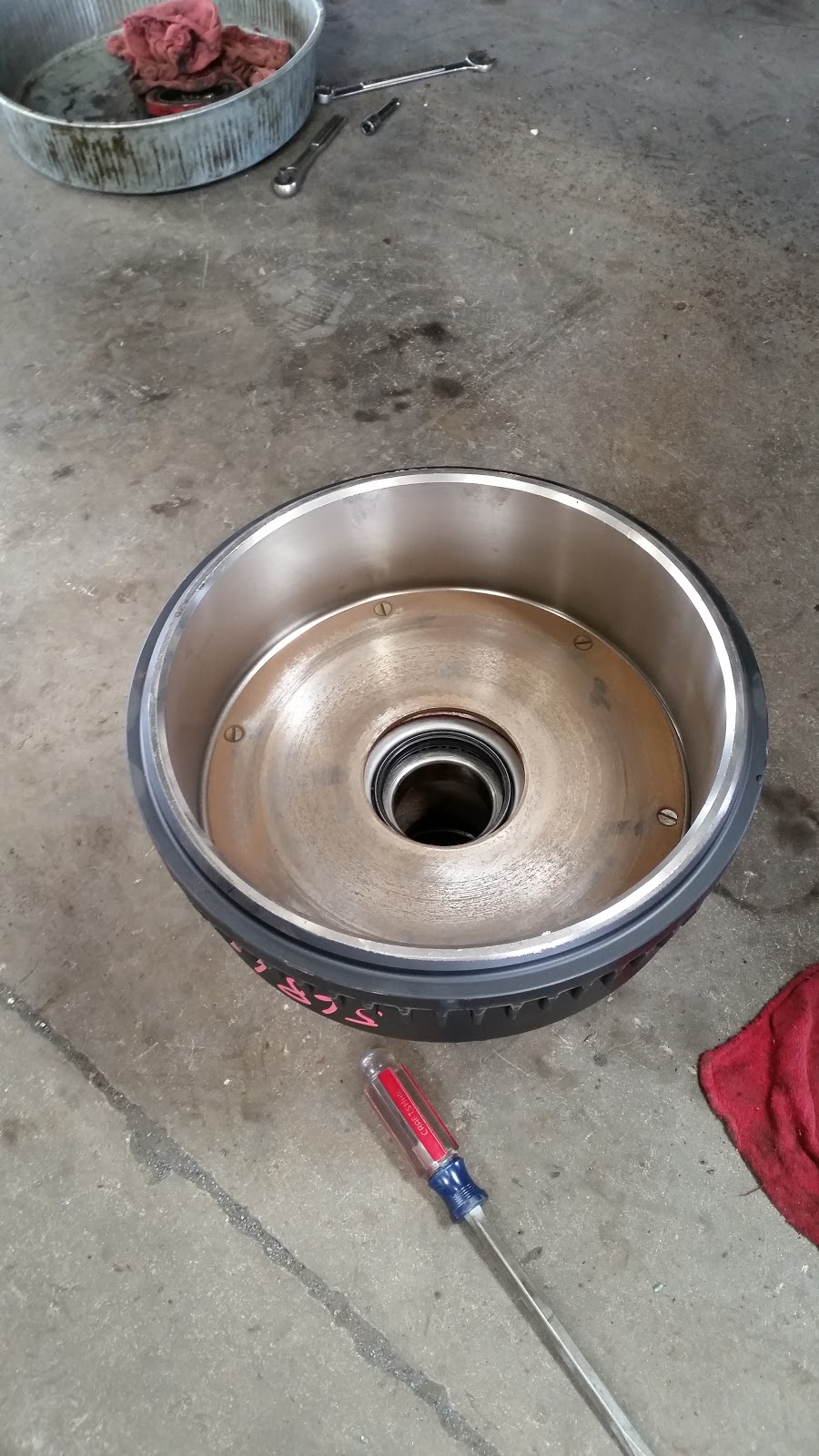
After pulling the Big 'Un to its new home, thought we'd give it the once over. The brakes weren't working on the trip over and besides it's always a good idea to give a used piece of equipment some TLC. This trailer had belonged to a hotshot driver, and we knew it had some mileage. Turns out is must have been driven to hell and back, twice. The brake drums were toast, several pieces of the brake hardware were missing or broken, and the axle seals were shot.
Fortunately, the previous owner had recently installed brake shoes and included several old backing plates with hardware that could be salvaged. So after buying new drums, seals, and magnets; everything was cleaned up and reinstalled.
So yes, plans were postponed and the job took longer than anticipated. But it is done and done and our plans can roll on.....
Went to look at a trailer today to haul shipping containers and my first thought was "that's a big un". I have been dragging trailers around since forever. Well not forever, but close to it. There have been homemade short box trailers, wide construction trailers, farm trailers, dump trailers, goosenecks, several different travel trailers, and tiny little sailboat trailers. Trailers have been hauled in the pouring down rain during rush hour traffic, cross-country on roads not wide enough for cars, directly into the setting sun, during the middle of the night on unknown backroads, with and without brakes, and many times overloaded in capacity. Every trailer is different yet all the same. Until today's trailer.
Today's trailer is 37', an impressive amount of trailer for anyone who has ever pulled a trailer! This is not a trailer you just hook on to and drag around through the neighborhood for funsies. No, this is a trailer where curbs are jumped, small cars are pushed off the road, takes four lanes to make a right turn and three for a left. This is the mother of all trailers. Don't get me wrong, there are plenty of long trailers out on the road, I just never noticed how long they were until buying one.
What's more impressive is the fact it used to be 40'. Bob, the older man who sold us this massive beast, has been pulling this around all over Texas and back just for work. He had it shortened for ease of maneuvering and load hauling. Load hauling, yeah right, He probably shorted it in order to get in and out of his suburbia neighborhood. I mean seriously, he had a driveway installed just for the trailer! Even though Bob was reluctant to part with his beloved trailer, he completed a final walk through. Trailer geek! He checked air pressure, tightened some loose boards, greased hubs, and found an extra tire for our usage. And these were only just a few of the many things he did to "prepare the trailer for its next trip".
Why would anyone not in the business of needing a trailer like this buy a trailer this specialized? Well, I am glad you asked. Plan473 is now in the business of hauling shipping containers. When all things are said and done, Plan473 will have purchased 8-10 shipping containers. Four for the shop, two for the house, one for the kid, one for storage, one for the business, and one for rentals/guests. Buying locally means that the seller has tacked on the shipping costs to his base purchase price. Depending on the seller, the costs can be as much as double of the wholesale prices. Sellers in Houston or San Antonio, where boxes are much cheaper, will ship to a destination at a price of $4 a mile. At a minimum of 300 miles round trip, it became financially clear we would be hauling our own shipping containers. Even with wear and tear on truck and trailer and time investment of each trip, the trailer will have paid for itself in the purchase of three shipping containers. Besides, once completed with this project the trailer can always be sold. Honestly, what I am gonna do with a 37' trailer? Take it to the grocery store?
It that not the most beautiful bottle of water you have ever seen? Look all you want but you can't have it. Sailors used to say, "water, water everywhere and not a drop to drink". Yup, salt water! Not slightly salty, where a Britta filter could be used, no SALTY. As in it might as well be drawn straight from the bay itself. A week has gone by since the well was completed and all progress to Plan473 has been put on hold. Who knows what this will mean for rescheduling, but without water, there is nothing.
Phone calls have been made to various local government officials, health departments, state resources, water filtration companies both local and national, other drill companies, and people you think would be able to offer assistance. Let me tell you right now that these people all refer to one another, yet not one person has an answer. Many hinted at in a non-supported basis to run the well for up to 48hours. Sometimes it takes a while for the well to clear out from being drilled. With the use a borrowed generator, the well was flushed again. Once again, water was wasted in attempts to produce drinkable water.
When this didn't resolve the issue calls were made again to these same people on what should be done next. The closest we came to a next step, not even a solution, was made by a nationwide water filtration company. It was suggested to have the water tested to show A) exactly how salty the water is and B) what other minerals were involved. Salt water was one issue but having hard salt water was another whole level of complexity. HARD WATER! Are you kidding me? We live less than a mile from the bay in the sandy soils of the coastal plains. There is not a natural rock to be found for miles!
After more frustrating phone calls, a third party testing lab was found an hour away. Having the water tested is no simple process. The well had to run for several more hours, one gallon of water was collected in an approved, secured transport container, and once collected it had to be delivered to the testing facility within 24 hours. The lab is testing for a wide variety of minerals and should have the results within ten-twelve days. Ahh....the waiting place.
I have heard of New York time, Central Standard time, and beach time. Where we live there is such a thing as local time. Locals have a love-hate relationship with what is referred to as "our city's name" time. This is a small mom and pop county of 20K people. There is no rush hour traffic, no rush to beat peak hours at the one and only grocery store, and there is surely no rush to get work done. In fact, the only rush experienced is by the summer and weekend tourists trying to accomplish vacation goals on their limited time frame. These are the people that speed through town, clog up the shopping stores, and complain about the general lazy manner of the locals. This city takes the coastal image of relaxation seriously.
And oh how FRUSTRATING that image can be when relying on others for a job to be done. The well man was referred to us by residents in new neighborhoods, long time residents in old established communities, and county officials. Wow, this company must be the best of the best! We should have well within a few weeks. Yeah, umm, no. After scheduling around "city" time, holidays, and backlogged work, the well man finally showed up with his crew of two.
Having grown up with a well, understanding the workings is not a new experience. A well is dug based upon reliable factors such as aquifer boundaries, water tables, and tidal plains. After attempting to get a better understanding of our geological structure and having no results, our well was dug based on the experience of our driller.
Having the crew show up in a truck leftover from a Mad Max movie gave me a few reserves. This skill is pre-historic in terms of revolutionary. The only advancement in the last 60 years is that the drill is now mechanically powered. Drill a hole, wash the dirt out, drill a hole, wash the dirt out. This process is slow, messy, and water wasteful.
Here we are at Plan473 trying to conserve water in a dry environment by installing items like low-flow toilets, shower heads, and faucets. Where gray water will be used to water plants and every building will have a collection barrel. The creation of a well requires lots of water. Being that city water is unattainable (more about that in another post), a well must be dug. In doing this, thousands of gallons of water was dumped into the yard where we are wasting water to create water.
After three days, 145 feet later, the well was completed. And golly, what beautiful water it is. Unfortunately, beautiful was the only positive descriptive available for our well water. What is the saying; Never judge a book by its cover, Looks can be deceiving, or Don't knock it until you try it?
Too bad none of those things applied here. What can be applied is: "Water, water everywhere and not a drop to drink". In short, what we have is pure-D, grade-A salt water. UGH. UGH. UGH. EXPLICIT! EXPLICIT! EXPLICIT!